I Built a DIY Moon Gate from an Old Trampoline
There are moments when I look around my garden and think, you know what this needs? A completely unnecessary giant DIY moon gate.
This was one of those moments.
I had an old trampoline frame and a garden. What could go wrong?
So I built a moon gate.
The plan was simple. Turn the curved trampoline frame into a giant moon, cover it in vines, and eventually let the plants take over until it looked less like something I built and more like something that had always been there.
Unfortunately, plants do not care about my timeline.
But we’ll get to that.

How an Old Trampoline Became a Giant DIY Moon Gate
I had saved the outer metal frame from my kids’ old 12-foot trampoline. I am forever the person that thinks, don’t throw that away—I might need it later.
Reader, I needed it later.
The frame came apart into sections, so I reattached all but three pieces, which left me with the crescent shape I wanted. I secured the sections together with metal glue and gave the whole thing a coat of spray paint.
And suddenly I had a moon.
A very large moon.
A very large moon that now needed to somehow stand upright in my garden.
Getting Her in the Ground
I carried the frame out to the spot I’d chosen, marked where each end met the ground, and dug two holes roughly 2 feet deep, angling them slightly to follow the direction of the frame.
Then I bought the largest rebar I could find, drove each piece a little farther into the earth, and slid the open ends of the trampoline frame down over the rebar.
I filled the holes back in, packed the soil around everything and—
she was standing.
Phew.
She wasn’t quite as sturdy as I wanted, though, and a twelve-foot piece of metal flopping around willy nilly in the middle of the garden seemed less whimsical than I was going for.
So I added heavy-duty stake straps that I also saved from the trampoline to the back, positioned where you can’t really see them from either side. That gave the frame the extra stability I wanted without ruining the illusion. I filled the holes back in..
And just like that:
I had a moon gate.
Now I just had to make her look like she belonged there.

Making it Look Like it had Always Been There
Building the moon was only half the problem. I didn’t want a shiny metal arch sitting in the middle of the garden. That was definitely not the vibe I was going for.
Fortunately, I have a literal forest behind my house.
Thick vines had grown up and around several of the trees back there, and some were becoming severe enough that I wanted them off the trees anyway. I honestly have no idea what kind of vines they were, so I’m not going to pretend otherwise. I pulled down the ones I could and saved the long, woody pieces.
Then I started wrapping them around the bottom of the moon gate.
Immediately better.
They twisted around the metal perfectly and gave the base that tangled, witchy, this has been sitting in the forest for a hundred years look I wanted.
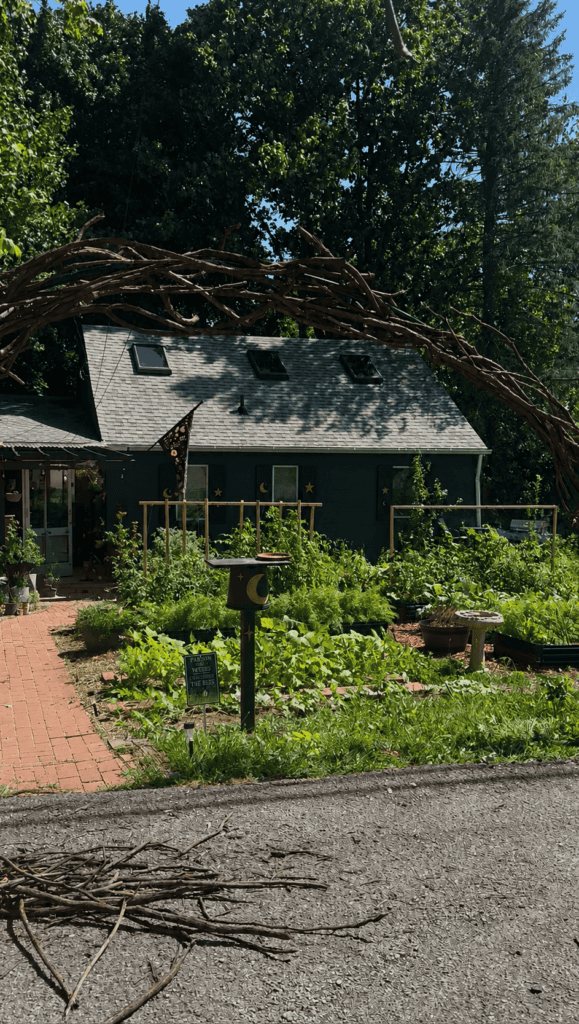


The Plan Was to Let Nature Take Over
At the base of each side, I planted Virginia creeper, a hardy native vine that I hoped would eventually climb the structure and do the decorating for me.
I had visions.
The Virginia creeper had other plans.
It grew, technically. Just nowhere near fast enough for someone who had already constructed a twelve-foot moon in her garden and would now like nature to please catch up.
So I waited.
And waited.
And then did what any patient and reasonable gardener would do.
I bought fake vines.
Look, I needed to see the vision. I will be taking them down at some point and reusing them for another project.
I wrapped strands of faux greenery through the real woody vines and around the frame, filling in all those painfully bare spaces while the actual plants take their sweet time figuring things out.
And finally, she started looking like the moon gate I’d had in my head all along.
And Obviously, She Needed to Glow
Because what kind of whimsical gardener would I be if the MOON didn’t GLOW?!
I wrapped solar fairy lights around the frame so that once the sun goes down, the moon softly lights up beside the garden.
And at night?
She’s ridiculous. She’s unnecessary. She’s perfect.
Some of the lights in the middle have already decided they no longer wish to participate, so that’s on the list of things Future Me gets to deal with.
But for now, I finally have the strange little garden portal I imagined when this whole thing started.
You can find the rest of my garden experiments, questionable projects, and ongoing attempts to make this place a little more magical in the Faelorehn Field Guide.

What I’d Do Differently
Honestly? Not much.
If I could go back to the beginning, I would spend a little more time researching the vines I wanted to grow over the moon gate—specifically how quickly they actually grow and how long it might take them to cover a structure this size.
The faux vines solved the immediate problem, and the real Virginia creeper can keep doing its thing underneath. Eventually, I’d love for the living vines to take over completely and let me remove the faux ones altogether. I have another project I want to use them for anyways.
Other than that? I wouldn’t change a thing.
She’s weird. She’s enormous. She’s a little impractical. But when the lights come on at night, she makes the whole garden feel like somewhere else entirely.
Which was 100% the point.
Entry No. 001 · August 2026
FIELD NOTES
The Moon Gate
Made from: Repurposed 12-foot trampoline frame
Anchored with: Rebar and concealed stake straps
Living vine: Virginia Creeper
Instant gratification vine: Faux ivy strands. Patience is a virtue I often lack.
Lighting: Solar warm fairy lights
Would I build it again? Immediately
Current status: Some lights have stopped working and I need to fix that. Otherwise, she is thriving and GLOWING.
What I used from Amazon: Amazon Moon Garden List
A note from the field: This is how I built my DIY moon gate, not an engineered construction plan. Ground conditions, frame materials, weather and stability will vary. If you make your own, use anchoring appropriate for your site and make sure the finished structure is secure before decorating or walking beneath it.